You open a bag of “healthy” veggie chips. The label says organic, non-GMO, and gluten-free. You pour a generous bowl because, let’s face it, they’re just vegetables, right? Two hours later, the bag is empty, your stomach still feels hollow, and somehow you’ve eaten 600 calories without ever feeling truly satisfied.
This isn’t a willpower problem. It’s an engineering problem.
Ultra-processed foods — the packaged snacks, frozen meals, sugary cereals, and flavored drinks that now dominate grocery store shelves — are scientifically designed to override your body’s natural fullness signals. They bypass the mechanisms that evolved over millions of years to regulate hunger. And the result is staggering: the average person eating a diet heavy in ultra-processed foods consumes roughly 500 extra calories per day without even realizing it.
That number comes from one of the most important nutrition studies of the past decade — a tightly controlled trial conducted at the National Institutes of Health. The findings have reshaped how scientists think about obesity, weight gain, and the modern food environment. In this article, we’ll break down what ultra-processed foods actually are, what the research reveals, why they trick your brain, and how to take back control without giving up convenience entirely.
What “Ultra-Processed” Actually Means
Not all processed foods are created equal. Cooking meat, pasteurizing milk, and baking bread are all forms of processing. The problem isn’t processing itself — it’s the degree and intent.
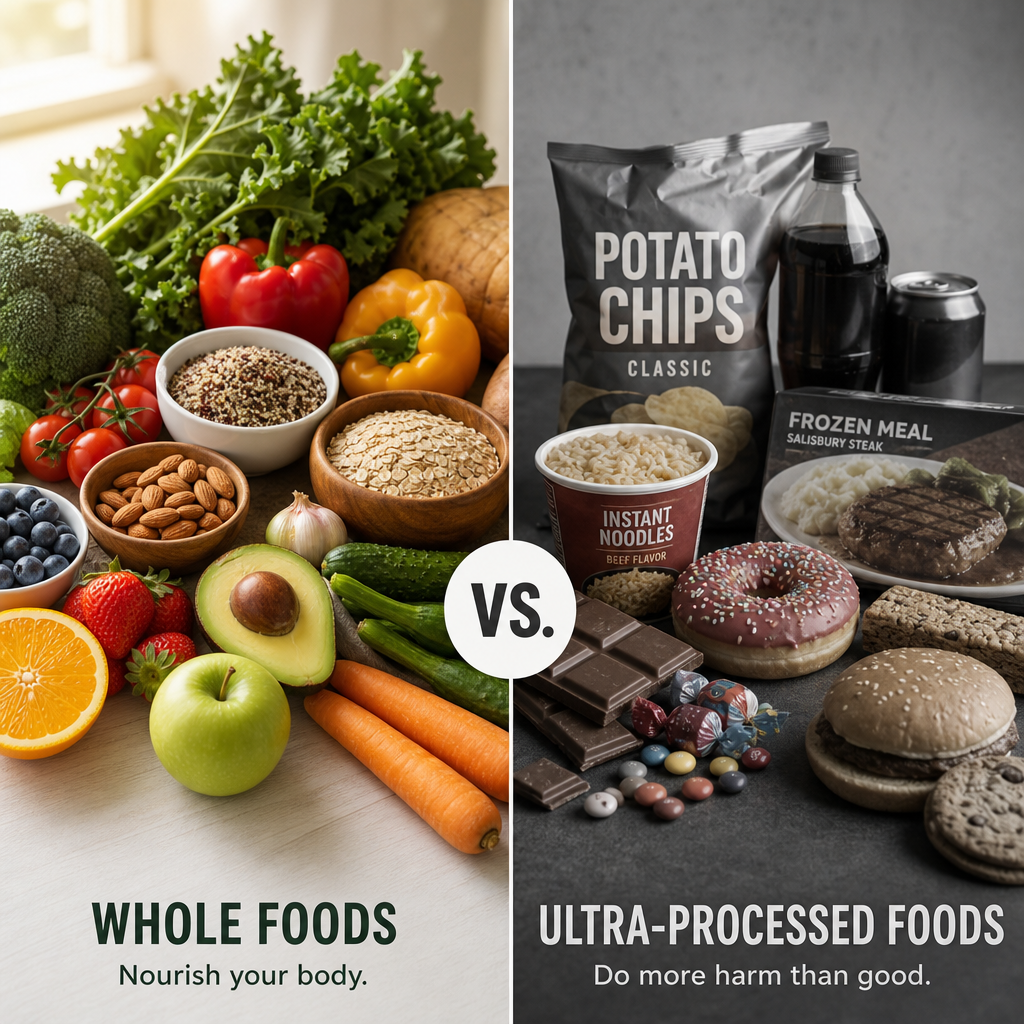
Researchers classify foods using the NOVA system, which divides them into four categories. At one end are unprocessed or minimally processed foods: fresh fruits, vegetables, eggs, raw nuts, and plain yogurt. At the other end are ultra-processed foods, defined as industrial formulations typically containing five or more ingredients, including substances not commonly used in home kitchens.
Think hydrogenated oils, high-fructose corn syrup, protein isolates, emulsifiers, artificial sweeteners, flavor enhancers, and synthetic dyes. These ingredients don’t exist in nature. They exist because they extend shelf life, reduce production costs, and — most importantly — make food hyper-palatable.
Ultra-processed foods include obvious suspects like soda, candy, and instant noodles. But they also include many items marketed as healthy: granola bars, protein shakes, plant-based burgers, flavored Greek yogurts, gluten-free crackers, and breakfast cereals with dried fruit. The packaging might feature words like “natural,” “whole grain,” or “high protein,” but the ingredient list tells the real story.
In the United States, ultra-processed foods now account for an estimated 58% of total calories consumed by adults and nearly 70% of calories consumed by children. In some European countries, the figure is even higher. We aren’t just eating these foods occasionally. They’ve become the default.
The NIH Study That Changed Everything
In 2019, a team led by researcher Kevin Hall at the National Institutes of Health published a study in the journal Cell Metabolism that sent shockwaves through the nutrition world. It was a randomized controlled trial — the gold standard of scientific evidence — and it was conducted with extraordinary precision.
Twenty adults were admitted to a metabolic ward for twenty-eight days. For two weeks, they were given an ultra-processed diet. For the other two weeks, they ate a minimally processed diet. Both diets were matched for total calories, sugar, fat, fiber, and macronutrients. The participants were told to eat as much or as little as they wanted. Food was weighed precisely. Activity levels were monitored. Nothing was left to chance.
The results were startling. When eating ultra-processed foods, participants consumed an average of 508 additional calories per day compared to when they ate minimally processed foods. Over the two-week period, they gained an average of 2 pounds. When switched to the minimally processed diet, they lost that same 2 pounds — despite eating the same amounts of sugar, fat, and protein.
The implications were profound. Weight gain wasn’t driven by sugar, fat, or lack of willpower. It was driven by the food itself — its texture, its speed of consumption, its palatability, and its ability to bypass satiety signals. The body simply didn’t register ultra-processed food as “enough” in the same way it registered whole foods.
Perhaps most striking was the speed at which participants ate. On the ultra-processed diet, they consumed food significantly faster. Ultra-processed foods tend to be softer, require less chewing, and dissolve more quickly in the mouth. This rapid eating rate short-circuits the body’s satiety mechanisms, which take roughly twenty minutes to fully activate after a meal begins.
How Ultra-Processed Foods Hijack Your Brain
Your brain contains a sophisticated reward system designed to reinforce behaviors essential for survival. When you eat calorie-dense food, dopamine is released. This creates pleasure and motivates you to seek that food again. It’s an elegant system — or at least it was, before modern food science learned to exploit it.
Ultra-processed foods deliver a concentrated, rapid hit of reward that whole foods rarely match. They combine sugar, salt, fat, and refined carbohydrates in ratios that don’t exist in nature. A ripe mango is sweet. A steak is savory. A potato is starchy. But a chocolate chip cookie? It hits all four pleasure centers simultaneously, and it does so with industrial precision.
This isn’t accidental. Food companies employ teams of scientists to optimize what they call the “bliss point” — the precise concentration of sugar, salt, and fat that maximizes craving and consumption. The goal isn’t to satisfy you. It’s to make you want more.
Research using functional MRI scans has shown that ultra-processed foods activate brain regions associated with craving and reward in ways similar to addictive substances. The more frequently these foods are consumed, the more the brain’s reward threshold shifts. Whole foods begin to taste bland by comparison. Vegetables seem boring. Fruit seems insufficiently sweet. This neuroadaptation makes it progressively harder to enjoy and choose less processed options.
Adding to the problem is the phenomenon of “sensory-specific satiety.” When you eat one food repeatedly, your desire for it diminishes — a mechanism that naturally limits overconsumption of any single item. Ultra-processed foods circumvent this by layering multiple flavors and textures into a single product. A single snack food might deliver salt, sugar, umami, and crunch in rapid succession, keeping your reward system engaged long after a simpler food would have triggered satisfaction.
The Hidden Metabolic Damage
The consequences of chronic ultra-processed food consumption extend far beyond weight gain. Emerging research suggests these foods inflict damage at the cellular level in ways that independent of their calorie content.
Gut microbiome disruption. Ultra-processed foods are typically low in fiber and high in emulsifiers, preservatives, and artificial sweeteners — all of which alter gut bacterial composition. A healthy gut microbiome depends on diverse fiber sources to produce short-chain fatty acids, which reduce inflammation and support metabolic health. Diets dominated by ultra-processed foods starve beneficial bacteria while promoting species associated with inflammation and metabolic dysfunction.
Chronic inflammation. Several large observational studies have found associations between ultra-processed food consumption and elevated markers of systemic inflammation. This may stem from gut microbiome changes, increased intestinal permeability, or the presence of advanced glycation end products formed during industrial processing. Chronic low-grade inflammation is now recognized as a root cause of heart disease, type 2 diabetes, and certain cancers.
Insulin resistance. The rapid absorption of refined carbohydrates in ultra-processed foods causes sharp spikes in blood glucose and insulin. Over time, this pattern can exhaust the body’s ability to manage blood sugar effectively, contributing to prediabetes and type 2 diabetes. The same total amount of carbohydrates consumed in whole-food form — think lentils, beans, or whole grains — produces a much gentler metabolic response.
Hormonal disruption. Some additives used in ultra-processed foods, including certain emulsifiers and packaging chemicals, have been shown in animal studies to interfere with endocrine function. While human data is still emerging, the precautionary principle suggests minimizing exposure to these compounds, particularly for children and pregnant women.
Why Willpower Alone Doesn’t Work
There’s a persistent myth that weight gain is primarily a failure of self-control. This myth serves the food industry exceptionally well, because it shifts blame from the environment to the individual. But the NIH study demolishes this argument.
Participants in the trial were literally locked in a research facility with no access to external food. They had no social pressures, no advertisements, no convenience stores. Their meals were provided. Their only job was to eat according to their natural hunger. And even under these ideal conditions — with maximum motivation, zero distractions, and complete accountability — they still overate by 500 calories per day when given ultra-processed foods.
If people overeat in a controlled laboratory setting with their full conscious attention, what chance does the average person have in a world where ultra-processed foods are cheaper, more convenient, more heavily marketed, and engineered to be irresistible?
The answer isn’t that willpower doesn’t matter. It’s that willpower is a finite resource, and modern food environments are specifically designed to deplete it. Every time you walk past a vending machine, scroll past a food ad, or open a pantry containing chips and cookies, you’re drawing on limited cognitive resources. Eventually, those resources run out.
Lasting change doesn’t come from trying harder. It comes from changing the environment so that the healthier choice becomes the easier choice.
How to Spot Ultra-Processed Foods in Disguise
Marketing language has become remarkably sophisticated at obscuring what foods actually are. Terms like “natural,” “wholesome,” and “clean” have no regulated legal definition. A product can advertise itself as healthy while being fundamentally ultra-processed.
The most reliable indicator is the ingredient list. If you see substances you wouldn’t find in a home kitchen — maltodextrin, soy protein isolate, carrageenan, hydrogenated oils, artificial sweeteners, or ingredients with chemical-sounding names — the product is ultra-processed regardless of what the front label claims.
Another clue is the number of ingredients. Whole foods have one ingredient: an apple is just an apple. Minimally processed foods might have two or three: plain yogurt contains milk and bacterial cultures. Once you cross five ingredients, particularly if several are preservatives, sweeteners, or emulsifiers, you’re in ultra-processed territory.
Pay attention to texture as well. Foods that are unnaturally soft, unnaturally crispy, or have a shelf life measured in months are almost certainly heavily processed. Real bread goes stale in a few days. Real cheese requires refrigeration. If a food violates basic principles of food physics, it’s been engineered to do so.
Finally, watch out for health halo effects. Gluten-free cookies are still cookies. Organic gummy bears are still candy. Plant-based burgers can contain more sodium and saturated fat than beef burgers. The absence of one problematic ingredient doesn’t redeem an otherwise ultra-processed formulation.
Practical Swaps That Actually Work
Completely eliminating ultra-processed foods isn’t realistic for most people, and it isn’t necessary. The goal is reduction, not perfection. Small, consistent substitutions can dramatically lower your overall intake without requiring a complete lifestyle overhaul.
Breakfast: Replace sugary cereals and flavored oatmeal packets with plain oats topped with fresh fruit, nuts, and a drizzle of honey. Swap breakfast bars for a couple of boiled eggs and a piece of fruit. Replace flavored yogurt with plain Greek yogurt and add your own berries.
Snacks: Trade chips and crackers for raw nuts, seeds, or vegetable sticks with hummus. Replace energy bars with a small handful of almonds and a square of dark chocolate. Choose whole fruit over fruit snacks or dried fruit with added sugar.
Lunch and dinner: Build meals around whole protein sources like chicken, fish, eggs, beans, or lentils. Use intact grains such as quinoa, brown rice, or whole wheat instead of instant versions. Add vegetables in their natural form rather than relying on packaged side dishes.
Beverages: Replace sodas and flavored drinks with water, sparkling water with lemon, unsweetened tea, or black coffee. Even diet sodas, while calorie-free, appear to negatively impact gut bacteria and metabolic health in ways that are still being studied.
Convenience foods: If you rely on frozen meals, look for options with short ingredient lists containing only recognizable foods. Better yet, batch-cook simple meals on weekends and portion them for the week. A pot of chili, a tray of roasted vegetables, or a batch of cooked grains takes minimal effort and provides multiple meals.
The 80/20 Approach to Realistic Change
Perfectionism is the enemy of progress. If you attempt to eliminate every trace of ultra-processed food from your diet, you’ll likely burn out, feel deprived, and eventually rebound. A more sustainable approach is the 80/20 framework: aim to make about 80% of your calories come from whole or minimally processed foods, and allow 20% for whatever you enjoy.
This isn’t a rule. It’s a mindset. On days when you’re traveling, stressed, or simply don’t have the bandwidth, your ratio might shift. That’s normal. What matters is the overall pattern over weeks and months, not any single meal.
Start with one meal. Breakfast is often the easiest to upgrade because it’s typically eaten at home and involves simple substitutions. Once that feels automatic, move on to snacks, then lunch, then dinner. Layer changes gradually rather than attempting everything at once.
Track how you feel, not just what you weigh. Many people notice improvements in energy, digestion, skin clarity, and sleep quality before the scale moves. These non-scale victories are often more motivating than numbers and signal that genuine metabolic changes are occurring beneath the surface.
The Bottom Line
Ultra-processed foods aren’t just “junk food” in the colloquial sense. They’re industrial products designed by scientists to maximize consumption, minimize satiety, and override your body’s natural regulatory systems. The NIH study proved what many suspected: even when macronutrients are matched, these foods cause people to eat hundreds of extra calories without awareness or intent.
The modern food environment makes avoidance difficult. Ultra-processed foods are everywhere, they’re heavily marketed, and they’re engineered to be irresistible. Expecting willpower to overcome this environment is like expecting someone to swim upstream indefinitely. Eventually, the current wins.
The solution isn’t self-flagellation. It’s strategic substitution. By gradually replacing ultra-processed items with whole and minimally processed alternatives, you shift the calorie equation without counting, restricting, or fighting your own biology. You eat foods that your body actually recognizes, processes efficiently, and registers as satisfying.
You don’t need to overhaul your entire diet tomorrow. You just need to start noticing what’s on your plate, reading ingredient lists with a critical eye, and making one better choice at a time. Your body already knows how to regulate hunger and maintain a healthy weight. It just needs food that lets it do its job.