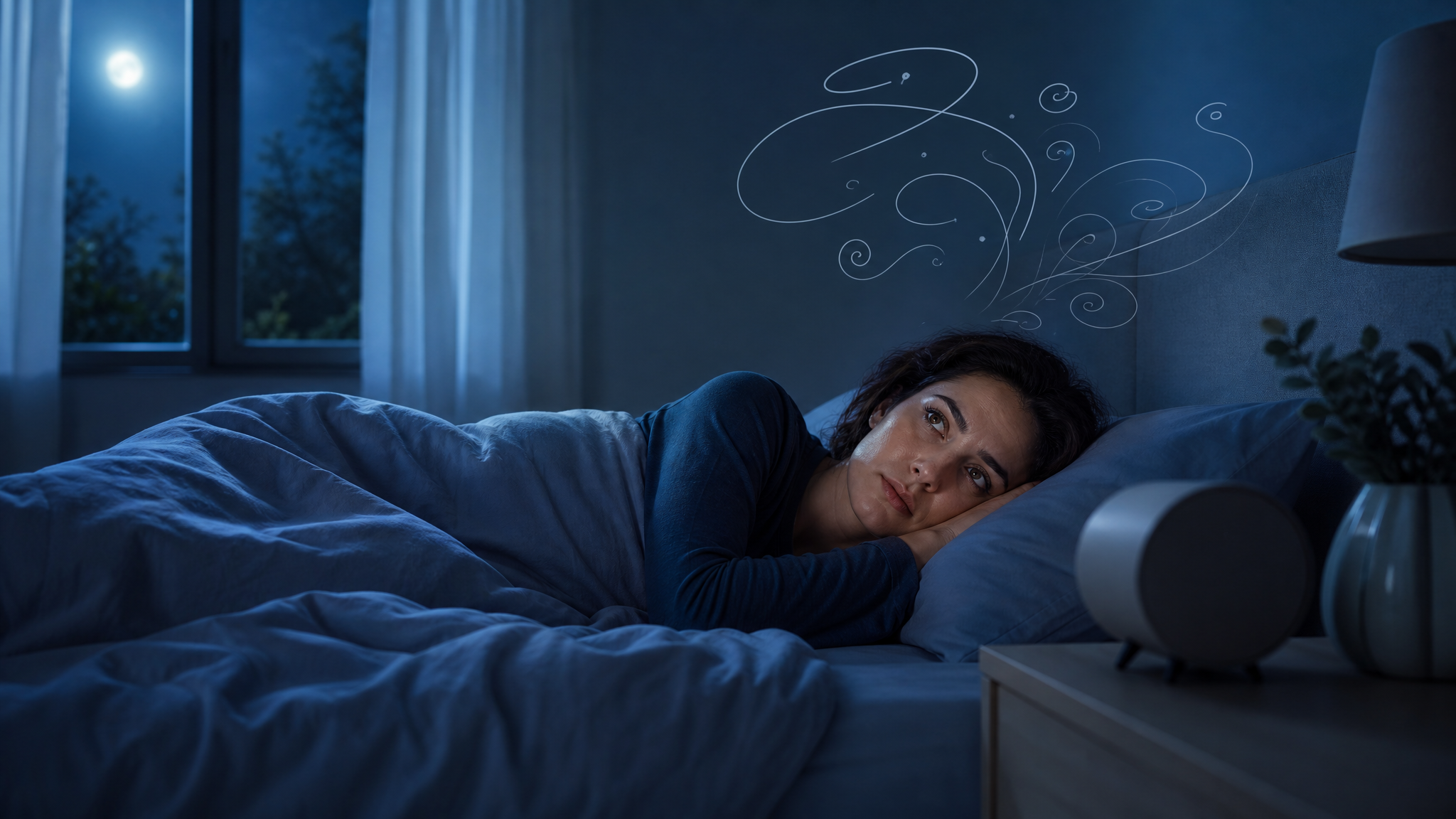
You are exhausted. You turned off the lights on time. You did the responsible thing. Then your brain decided to hold a meeting.
First comes the clock check: 11:47 PM. Then the calculation: if you fall asleep right now, you can still get six hours and forty-three minutes. A few minutes later, you check again. Now it is 12:18 AM, and the math feels worse. Your chest tightens. You start trying harder to sleep, which somehow makes sleep feel even farther away.
This frustrating loop has a name: sleep anxiety. It is not just ordinary stress before bed. It is the fear of not sleeping, the pressure to perform sleep correctly, and the panic that tomorrow will be ruined if you do not drift off soon. The cruel part is that sleep anxiety can turn the bed into a place of effort, monitoring, and worry — exactly the opposite of what your nervous system needs.
The good news is that sleep anxiety is not a character flaw, and it is not solved by more willpower. In fact, trying to force sleep is usually the trap. The way out is to reduce the pressure around sleep, retrain your brain to associate bed with rest instead of struggle, and use habits that calm the body without turning bedtime into a high-stakes project.
What Is Sleep Anxiety?
Sleep anxiety is anxiety focused on sleep itself. You may worry that you will not fall asleep, that you will wake up too early, that you will be useless the next day, or that your health is being damaged every time you have a bad night. Instead of bedtime feeling like a natural transition, it becomes something you brace for.
People with sleep anxiety often describe a familiar pattern. They feel tired on the couch, but the moment they get into bed, their mind becomes alert. They monitor every sensation: Am I sleepy enough? Is my heart beating too fast? Why am I still awake? They may start testing whether sleep is happening, which keeps the brain in a watchful state.
Insomnia itself is common. The National Heart, Lung, and Blood Institute describes insomnia as trouble falling asleep, staying asleep, or getting good-quality sleep even when there is enough time and a suitable environment for sleep. Short-term insomnia can happen during stress or schedule changes, while chronic insomnia occurs at least three nights per week for more than three months. Sleep anxiety can be both a cause and a consequence of insomnia: a few bad nights create fear, and fear makes more bad nights more likely.
That does not mean every restless night is a disorder. Everyone has occasional nights when the brain refuses to cooperate. Sleep anxiety becomes a problem when worry about sleep starts shaping your evenings, your mood, and your behavior. If you dread bedtime, cancel plans because you are afraid they will affect sleep, or spend the day obsessing over how the night will go, the anxiety may be reinforcing the very sleep problem you are trying to fix.
Why Trying Harder Makes Sleep Harder
Sleep is strange because it is essential, but it cannot be forced directly. You can create the conditions for sleep, but you cannot command it the way you can command yourself to stand up or send an email. The harder you try to make sleep happen, the more the brain treats sleep as a task that requires attention.
Attention is the problem. Falling asleep requires a gradual drop in alertness. Your body temperature shifts, breathing slows, muscle tone relaxes, and the brain moves away from active problem-solving. But when you are trying to sleep, you are checking, evaluating, and predicting. That keeps the brain engaged.
This is why the thought “I have to sleep now” often backfires. It sounds reasonable, but the nervous system hears urgency. Urgency activates the stress response. Your heart rate may increase, your breathing may become shallow, and your thoughts may speed up. Then you notice those sensations and conclude that something is wrong, which creates more arousal.
It is a little like trying to remember a word that is on the tip of your tongue. The more aggressively you chase it, the more it hides. Then, when you stop forcing it and think about something else, the word suddenly appears. Sleep often works the same way. It comes more easily when you stop gripping it so tightly.
The Bed-Brain Connection
Your brain is constantly learning associations. If you repeatedly eat popcorn while watching movies, popcorn starts to feel like movie food. If you always check your phone when you hear a notification, the sound creates a small urge to look. Sleep works through associations too.
Ideally, the bed becomes a cue for sleep. You get in, the room is dark, the routine is familiar, and the brain predicts rest. But when you spend hours awake in bed worrying, scrolling, arguing with your thoughts, or watching the clock, the bed can become a cue for wakefulness. You may feel sleepy in the living room and wired the moment your head hits the pillow because your brain has learned that bed is where the nightly battle happens.
This is one reason cognitive behavioral therapy for insomnia, often called CBT-I, includes “stimulus control.” The goal is to rebuild the bed-sleep association. Sleep Foundation describes CBT-I as a structured, evidence-based approach that targets the thoughts and behaviors that maintain insomnia. Common components include stimulus control, sleep restriction or compression, relaxation techniques, cognitive restructuring, and sleep hygiene education.
Stimulus control does not mean you are failing if you are awake in bed. It means you are training your brain with repetition. If the bed has become a worry zone, you gently stop practicing wakefulness there. Over time, the brain can relearn that bed is for sleep and intimacy, not for mental courtroom drama at 1 AM.
The Clock Is Making It Worse
Clock-watching is one of the most common sleep anxiety habits, and it is almost always gasoline on the fire. Every time you check the time, you give your brain new material for panic: how long you have been awake, how little sleep remains, how bad tomorrow might be.
The clock also turns the night into a performance review. Instead of resting, you start grading yourself. Midnight becomes a warning. 2 AM becomes a crisis. 4 AM becomes evidence that the day is doomed. None of those interpretations help the body sleep.
If you use your phone as an alarm, the problem gets worse because checking the time can become checking messages, email, news, or social media. Even a quick glance can expose you to bright light and emotionally stimulating information. Your brain does not need a world news update while it is trying to power down.
The fix is simple but not always easy: remove visible clocks from the bedroom, turn the alarm face away, and keep your phone out of reach if possible. If you wake during the night, you do not need to know the exact time. You only need to give your body another chance to rest.
What To Do When You Cannot Fall Asleep
The standard advice is to get out of bed if you cannot sleep after about 20 minutes. But do not turn this into another clock-based rule. The better version is: if you feel wide awake, frustrated, or increasingly anxious, leave the bed for a short reset.
Go somewhere dim and quiet. Sit in a chair. Read something calm and not too interesting, listen to quiet audio, or practice a simple relaxation exercise. Keep lights low. Do not start work, clean the kitchen, watch intense shows, or scroll through content designed to keep you engaged. The goal is not entertainment. The goal is to lower the charge around being awake.
Return to bed when you feel sleepy again, not when you think you “should” be asleep. This may feel annoying at first, especially if you are used to staying in bed and fighting. But the point is to stop teaching your brain that bed is where you rehearse insomnia.
If you wake up again and the same anxious loop starts, repeat the reset. Calm repetition is what retrains the association. It is not a quick hack; it is a learning process.
Use Relaxation Without Turning It Into a Test
Relaxation techniques can help, but only if you use them as a way to rest rather than as a pass-fail sleep device. The National Center for Complementary and Integrative Health explains that relaxation techniques are practices that help bring about the body’s relaxation response, characterized by slower breathing, lower blood pressure, and reduced heart rate. Examples include progressive muscle relaxation, guided imagery, breathing exercises, and autogenic training.
For sleep anxiety, progressive muscle relaxation is especially useful because it gives the mind something concrete and boring to do. Start at your feet. Gently tense the muscles for a few seconds, then release. Move through calves, thighs, hands, arms, shoulders, jaw, and face. The goal is not to knock yourself out. The goal is to teach the body the difference between tension and release.
Breathing can also help, but avoid overcomplicating it. Try breathing in through the nose for a comfortable count of three or four, then exhaling slightly longer. Long, relaxed exhales can signal safety to the nervous system. If counting makes you more anxious, drop the counting and simply make the exhale slow.
Guided imagery works for some people because it shifts attention away from sleep monitoring. Imagine a familiar calming place in detail: the path, the colors, the temperature, the sounds. If your mind wanders back to worry, that is normal. Gently return to the image without scolding yourself.
Change the Thought That Fuels the Panic
Sleep anxiety often runs on catastrophic predictions. “If I do not sleep eight hours, tomorrow is ruined.” “I will get sick.” “I will lose control.” “I cannot function unless tonight is perfect.” These thoughts feel convincing at 2 AM, but they are usually exaggerated.
A more helpful thought is not fake positivity. Do not tell yourself, “Everything is amazing,” if you do not believe it. Use something balanced: “I have handled tired days before.” “Resting quietly still helps my body.” “One bad night is uncomfortable, not dangerous.” “My job is to create conditions for sleep, not force it.”
This kind of cognitive reframing is a core part of CBT-I. You are not trying to win an argument with your brain. You are taking away the emergency signal. The less your brain treats wakefulness as a threat, the easier it becomes for sleep to return naturally.
It can also help to schedule a short worry window earlier in the evening. Spend 10 minutes writing down what is on your mind and one next step for each item. Then close the notebook. If the same worries appear in bed, remind yourself that they have been logged. Bedtime is not the planning meeting.
Build a Wind-Down Routine That Is Boring on Purpose
A good wind-down routine does not need to be aesthetic. It does not require expensive supplements, special pajamas, or a perfect bedroom. It needs to be predictable, calming, and repeatable.
Start about 30 to 60 minutes before bed. Dim bright lights. Put work away. Set your alarm once. Move your phone away from the bed. Do basic hygiene in the same order. Choose one quiet activity: reading, stretching, calm music, prayer, journaling, or breathing. Keep it boring enough that your brain does not want to stay up for the next chapter of stimulation.
Consistency matters because the routine becomes a cue. Over time, your brain starts to recognize the pattern: the day is ending, demands are decreasing, sleep is approaching. This cue is especially helpful for people whose minds stay active until the last possible second.
Be careful not to make the routine too elaborate. If bedtime requires twelve steps, you may create more pressure. The best routine is one you can do on an ordinary tired night.
When Sleep Anxiety Needs Professional Help
If sleep anxiety is occasional, the strategies above may be enough. But if insomnia is happening several nights a week, lasting for months, or affecting your mood, work, driving, relationships, or health, it is worth talking with a healthcare professional. Chronic insomnia is treatable, and CBT-I is often recommended as a first-line option because it addresses the cycle that keeps insomnia going.
You should also seek medical advice if sleep problems come with loud snoring, gasping, restless legs, panic attacks, depression, medication changes, chronic pain, or symptoms that feel unusual for you. Not every sleep problem is “just stress.” Sometimes the right fix depends on identifying an underlying issue.
Sleep medication may be appropriate in some cases, but it should not be the only conversation. Pills may help short-term sleep, but they do not always retrain the fear and habits around sleep. A clinician can help you choose a plan that fits your situation.
The Bottom Line
Sleep anxiety is exhausting because it turns rest into a job. You lie down hoping to recover, then spend the night trying to control something that works best when it is allowed to happen.
The solution is not to care less about sleep. Sleep matters. The solution is to stop treating every night like a test. Hide the clock. Leave the bed when frustration takes over. Use relaxation as rest, not as a weapon. Challenge catastrophic thoughts. Build a simple routine. And if the cycle has become chronic, get help from someone trained in insomnia treatment.
Your body already knows how to sleep. The work is not forcing it. The work is removing the pressure, cues, and habits that keep convincing your brain it needs to stay on guard.