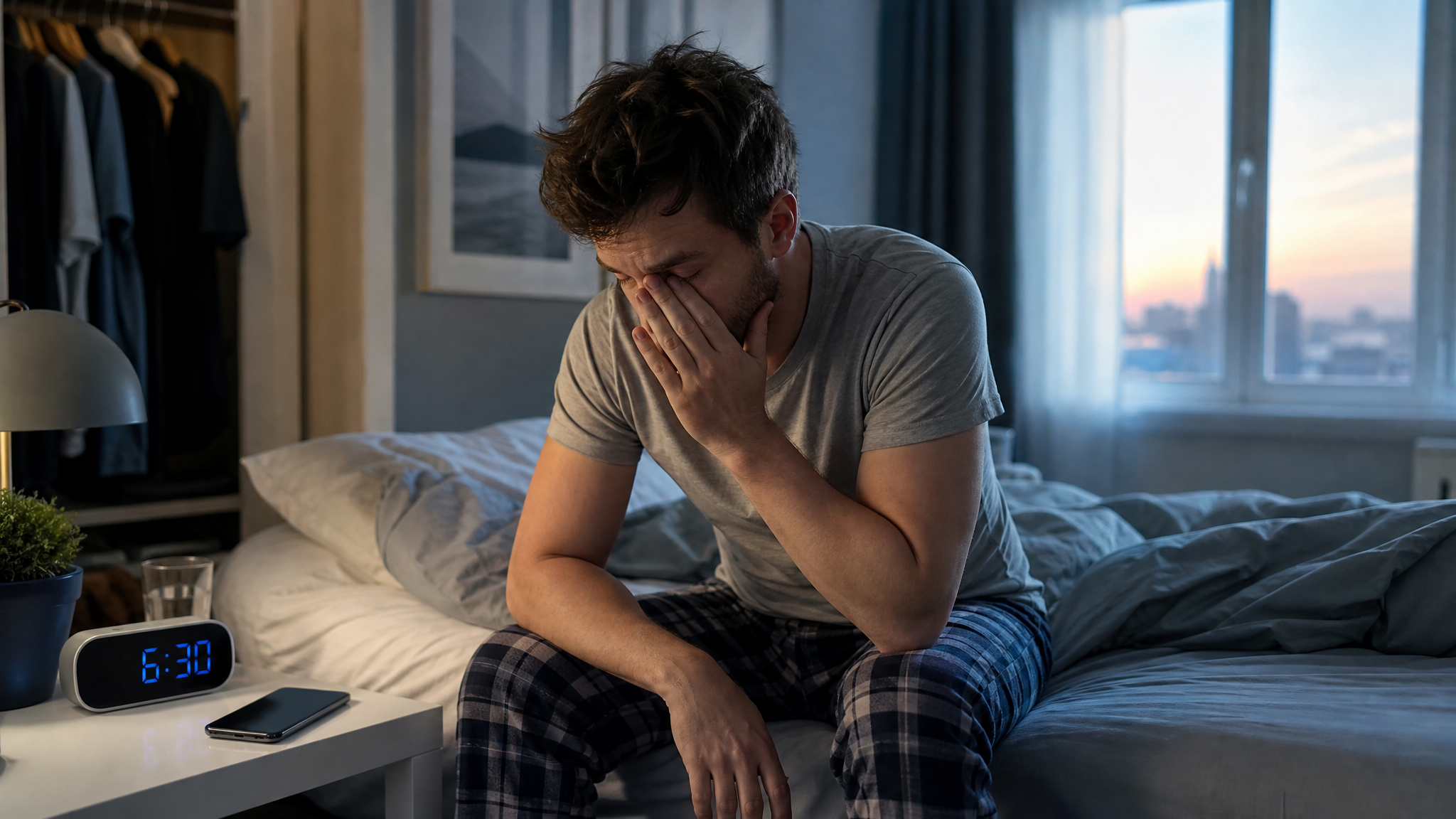
You promise yourself Sunday night will be different. You will be in bed early, wake up refreshed, and start Monday like a person who has their life together. Then the weekend happens: dinner runs late, one more episode turns into three, you sleep until 10 AM, and by Monday morning your alarm feels like it is going off in another time zone.
That groggy, slightly hungover feeling after a weekend of late nights has a name: social jet lag. You do not need to fly across the world to experience it. All it takes is a big gap between the sleep schedule your body wants on workdays and the one you follow on free days.
Social jet lag is common because modern life practically engineers it. Work, school, parenting, commuting, screens, and social plans all compete with the body’s internal clock. The result is a weekly rhythm where people drag themselves through early mornings, then try to “catch up” by staying up and sleeping in on weekends. It feels harmless, even deserved. But for many people, that pattern is the hidden reason Monday feels so brutal.
What Is Social Jet Lag?
Social jet lag is the mismatch between your biological clock and your social schedule. Your biological clock, also called the circadian rhythm, is the roughly 24-hour timing system that helps regulate sleep, alertness, digestion, body temperature, hormones, and metabolism. Your social schedule is the clock the outside world imposes: your alarm, your job, school start times, social plans, late-night messages, and weekend freedom.
When those two clocks line up, sleep feels easier. You get sleepy at a predictable time, wake up without feeling destroyed, and have more stable energy during the day. When they drift apart, your body may be trying to sleep while your calendar demands productivity, or trying to wake while your brain still thinks it is the middle of the night.
The classic social jet lag pattern looks like this: you wake at 6:30 AM Monday through Friday, but on Friday and Saturday you stay up past midnight and sleep until 9:30 or 10:00 AM. That three-hour shift may not sound dramatic, but your circadian system experiences it like changing time zones. By Sunday night, your body is not ready for an early bedtime. By Monday morning, the alarm arrives before your internal clock has finished the night.
Why Weekend Sleep-Ins Can Backfire
Sleeping in after a short night is not automatically bad. If you are sleep deprived, extra sleep can help reduce some of the pressure. The problem is not one occasional lazy morning. The problem is a repeated pattern of shifting your sleep window several hours later every weekend and then snapping it back every Monday.
Your circadian rhythm does not adjust instantly. Light exposure, meal timing, activity, caffeine, and bedtime habits all send timing signals to the brain. When you sleep late on Saturday and Sunday, you miss the morning light that normally anchors your clock. If you also stay up late under bright indoor light or phone light, you push the clock later again. By the end of the weekend, your body has received a strong message: bedtime is later now, and wake time is later too.
Then Monday demands the opposite. You force an early wake-up, often with too little sleep, and spend the first half of the day fighting sleep inertia. That is the heavy, slow, foggy state that can happen when you wake during a deeper part of your sleep cycle or before your body is ready. Coffee can mask it, but it does not fully reset the clock.
This is why some people feel more tired after “catching up” on sleep. They did get more hours, but they also shifted their timing. Sleep health is not only about total hours. The CDC notes that good sleep depends on both enough sleep and good sleep quality, and consistent habits such as going to bed and getting up at the same time every day support healthier sleep. Timing matters.
The Hidden Signs You Have Social Jet Lag
Social jet lag does not always announce itself as insomnia. It can look like a personality flaw, a motivation problem, or just “not being a morning person.” The clues are usually in the weekly pattern.
You may be dealing with social jet lag if Monday and Tuesday feel dramatically harder than the rest of the week. You might wake up with a dry, heavy feeling in your eyes, feel nauseated at breakfast, or need multiple alarms to get moving. Your mood may dip at the beginning of the week, and your focus may not fully come online until late morning.
Another sign is Sunday night restlessness. You know you need to sleep, but your brain does not cooperate. This is not necessarily anxiety, although anxiety can make it worse. Often, your body simply is not ready. If you slept until 10 AM on Sunday, trying to fall asleep at 10 PM that night is like asking your body to sleep at what feels like early evening.
Cravings can also show up. When sleep timing is inconsistent, appetite hormones and reward circuits can be affected. Many people notice stronger cravings for sugar, salty snacks, or extra caffeine after a disrupted weekend. That can create a second problem: late caffeine and heavy evening meals make it harder to fall asleep, which keeps the cycle going.
How Social Jet Lag Affects Your Body
The body likes rhythm. Your brain uses predictable patterns of light, food, movement, and rest to coordinate thousands of biological processes. When your sleep schedule swings back and forth, those processes become less synchronized.
One major effect is on alertness. The circadian rhythm creates natural peaks and dips in energy. If your clock is delayed from late weekend nights, your Monday morning alertness peak may arrive later than your workday requires. That can mean slower reaction time, weaker attention, and more mistakes. It is not laziness; it is timing.
Metabolism may also be affected. Sleep timing influences insulin sensitivity, hunger, and how the body handles food. Late nights often come with late eating, alcohol, snacking, and irregular meal times. Even if the total calories are not extreme, the inconsistent timing can make the body feel less stable. Some research on circadian misalignment links irregular sleep schedules with higher risk markers for weight gain and metabolic problems.
Mood is another common casualty. Poor sleep and irregular sleep timing can make the nervous system more reactive. Small problems feel bigger. Patience gets thinner. Motivation drops. The person who feels optimistic on Saturday afternoon may feel strangely hopeless on Monday morning, even though nothing major has changed except sleep timing.
There is also a stress effect. If every Monday begins with rushing, oversleeping, skipped breakfast, and panic, your body learns to associate the start of the week with threat. That stress can make Sunday sleep even harder, creating a loop where social jet lag and Monday anxiety feed each other.
The One-Hour Rule That Makes the Biggest Difference
The simplest way to reduce social jet lag is to keep your wake-up time within about one hour of your weekday schedule, even on weekends. That does not mean you can never enjoy a slow morning. It means avoiding a huge swing that forces your body to restart the clock every week.
If you normally wake at 6:30 AM, a weekend wake time around 7:30 or 8:00 AM is usually much easier on your system than 10:30 AM. If that sounds painful, it is a clue that you may be running a sleep debt during the week. The answer is not to punish yourself on weekends; it is to gradually move weekday bedtime earlier so you are not relying on weekend recovery.
For people with very early weekday alarms, a strict one-hour difference may not be realistic every weekend. In that case, aim for a smaller shift than usual. If you normally sleep three hours later, try two. Once that feels normal, try ninety minutes. Circadian rhythm responds well to consistency, not perfection.
The wake-up time matters more than bedtime because morning light is one of the strongest signals to the brain. A consistent wake time gives your body a daily anchor. Bedtime then becomes easier to adjust because sleep pressure builds at a more predictable pace.
Use Morning Light Like a Reset Button
Light is the master cue for the circadian clock. Bright light in the morning tells the brain that the day has started. This helps suppress melatonin, increase alertness, and shift your rhythm earlier. If you wake up and stay in a dim room scrolling under a blanket, your body receives a weak signal. If you get outside or sit near bright daylight, the signal is much stronger.
The practical version is simple: within the first hour of waking, get 10 to 20 minutes of outdoor light if possible. You do not need to stare at the sun. A walk, coffee on a balcony, or even standing outside while checking messages can help. Cloudy daylight is still much brighter than most indoor lighting.
This is especially useful on Saturday and Sunday. If you wake at a reasonable time and get morning light, you protect your Monday. You can still have a relaxed weekend, but you are less likely to push your clock so late that Sunday night becomes a battle.
Evening light matters too. Bright screens and overhead lights late at night can delay sleepiness. You do not need to live by candlelight, but dimming lights in the last hour before bed and using warmer screen settings can reduce the “it is still daytime” message your brain receives.
What to Do If You Stayed Up Too Late
Real life happens. Weddings, travel, family events, late dinners, and good conversations are part of being human. The goal is not to become the sleep police. The goal is to recover without turning one late night into a three-day fog.
If you stay up late, avoid sleeping half the day if you can. Instead, allow a modest sleep-in, then get morning or late-morning light as soon as possible. A short nap can help later, but keep it brief: 20 to 30 minutes is enough for a refresh without stealing too much sleep pressure from the night ahead. Try not to nap late in the day.
Be careful with caffeine. After a late night, it is tempting to keep refilling coffee into the afternoon. But caffeine can stay active for hours, and late caffeine often delays the next bedtime. A good rule is to keep caffeine to the morning or early afternoon, especially if you are trying to get back on track.
Meals can help reset the rhythm too. Eat breakfast or lunch at a normal time rather than grazing all day. Keep dinner earlier and lighter if possible. Heavy late meals can raise body temperature and digestive activity when your body is trying to wind down.
The Sunday Night Strategy
Sunday night is where social jet lag usually shows up, so it deserves a specific plan. The mistake most people make is trying to force sleep with willpower. That rarely works. A better approach is to create conditions that make sleep more likely.
Start by protecting Sunday morning. Do not let the day begin at noon unless you truly need recovery from an unusual event. Get light early, move your body, and keep meals on a fairly normal schedule. This sets up the night before you even think about bedtime.
In the evening, create a gentle landing. Write down Monday’s top three tasks so your brain does not rehearse them in bed. Pack what you can. Choose clothes. Set the coffee maker. These small actions reduce the sense that Monday is a threat waiting in the dark.
Then give yourself a real wind-down window. Thirty to sixty minutes is enough. Lower the lights, stop work messages, avoid intense shows or arguments, and do something repetitive and low-stimulation: reading, stretching, showering, breathing exercises, or quiet music. The point is not to perform a perfect routine. The point is to send the same message every week: the weekend is closing, and the body can power down.
When Social Jet Lag Is Not the Whole Story
Sometimes a consistent schedule does not fix the problem because another sleep issue is involved. If you regularly get enough hours but still wake exhausted, snore loudly, gasp during sleep, have morning headaches, or feel dangerously sleepy during the day, talk with a healthcare professional. Sleep apnea, restless legs syndrome, depression, anxiety, thyroid problems, medication effects, and other conditions can all mimic simple sleep deprivation.
It is also worth getting help if your sleep schedule is severely delayed and you cannot fall asleep until very late no matter what you try. Some people have delayed sleep-wake phase disorder, a circadian rhythm condition that may need structured light exposure, carefully timed melatonin, or guidance from a sleep specialist.
And if your work schedule involves night shifts or rotating shifts, the advice is different. Shift work creates a more complex circadian challenge. Consistency still helps, but you may need a plan built around your actual work hours, light exposure, and safety needs.
The Bottom Line
Social jet lag is what happens when your weekend schedule pulls your body into a different time zone and Monday yanks it back. The result can be grogginess, cravings, poor focus, low mood, and that familiar Sunday night frustration where you are tired but not sleepy.
The fix is not to eliminate fun or wake up at dawn every Saturday. The fix is to reduce the swing. Keep weekend wake times closer to weekdays, get morning light, avoid late caffeine, use short naps strategically, and make Sunday night easier on your nervous system.
If Monday always feels like a punishment, your motivation may not be the problem. Your clock may simply be confused. Give it a steadier rhythm, and the start of the week can feel a lot less like jet lag without the vacation.
Disclaimer: This article is for informational purposes only and is not a substitute for professional medical advice. If sleep problems are persistent, severe, or affecting your safety, speak with a qualified healthcare provider.